
B&R LOCKSMITHS · HELP & ADVICE
Locksmith Questions & Answers
Straightforward answers about lock repairs, door problems, costs and security. Browse the topics below, or send us a photo if you’re not sure what you have.
24/7 emergency locksmiths · No call-out charge · We come to your address
What would you like to know?
Dealing with a fault right now? Our “What’s wrong with my door?” guide starts with the symptoms you can see.
Booking, costs and emergency help
How much does a locksmith cost?
The price depends on the job, the type and condition of the lock, any parts needed and the time of the visit. A straightforward cylinder change can involve less work than opening a failed multipoint mechanism. We have no call-out charge; labour and any parts are chargeable. We explain the likely cost before work begins wherever possible and discuss any changes if an inspection reveals more work.
Can a locksmith open my door without damaging it?
In many cases, yes. We aim to use suitable non-destructive entry methods first, but the outcome depends on the lock, its condition and why the door is stuck. We will assess the situation and explain the approach; we cannot guarantee damage-free entry for every lock or fault.
Will my lock need to be drilled?
Not necessarily. Drilling is one entry method, not the automatic starting point. A faulty or damaged lock may need a different approach from a working lock with keys left inside. We assess the options and explain when a replacement lock is likely to be needed.
Can you help if I am locked out?
Yes. We provide 24/7 emergency locksmith help when keys are lost, left inside or a lock has failed. Call us with your postcode and describe the door and what has happened. We will discuss availability and the likely next step. See our emergency locksmith service.
How do I know if I need an emergency locksmith?
Call for urgent help if you are locked out, cannot lock the door, have a broken key preventing you from securing the property, or have damage after a break-in. If the door is still secure and a lock is only starting to feel stiff, a planned appointment may be suitable. Getting it checked early can help avoid a later lockout.
What information should I give you when I call?
Tell us your postcode, whether the door is open or locked shut, what happens when you use the key or handle, and when the problem started. Mention any damage and whether the property can be secured. You do not need to know the brand or technical name; clear photos are helpful if available.
Door faults and repair options
Why won’t my uPVC door lock?
Possible causes include a door that has dropped, locking points that no longer align with the keeps, a worn gearbox or a faulty cylinder or handle. If it works differently with the door open and closed, tell us. Avoid forcing it. Our door-problem guide explains common symptoms, and we can assess the fault before recommending a repair.
Why do I have to lift or push my door to lock it?
Lifting the handle is normal on many multipoint doors. Having to lift the whole door, lean on it or pull it hard is different and may suggest misalignment. The locking points can rub against their keeps when the door moves. Forcing the handle adds strain, so have the alignment and mechanism checked.
Why has my door handle gone floppy?
A loose fixing, worn spindle, failed handle spring or fault within the gearbox can all cause a floppy handle. It is not enough on its own to confirm a failed gearbox. Tell us whether the handle still works the latch and whether the door is locked shut. We can inspect the parts and identify a suitable repair.
Why does my key turn but the door won’t open?
The cylinder may be turning without moving the internal lock mechanism. On uPVC or composite doors, a gearbox or another multipoint component may have failed while the door was locked. Avoid forcing the handle or key. We can assess how to open the door and which components need attention.
Can you replace just the gearbox in a uPVC door?
In many cases, yes. If the gearbox is the failed part, a compatible replacement is available and the rest of the locking strip is sound, replacing the gearbox alone may be practical. We need to identify the mechanism and check its condition before confirming that option.
Do I need a whole new multipoint locking mechanism?
Not always. A gearbox or another individual component may be replaceable. A complete mechanism can be the better choice if several parts are worn or damaged, or a compatible repair part is unavailable. We will explain the options and costs after assessment.
Can you repair a lock instead of replacing it?
Often, yes. A door adjustment, handle repair or replacement of one worn component may solve the problem. If a lock is badly worn, damaged or no longer suitable for the required security, replacement may be more practical. We consider the condition, parts availability and cost. Read about lock repairs and replacements.
Why is my lock getting stiff?
Wear or a fault in the cylinder can make a lock stiff, but so can pressure from a misaligned door. If the handle is also harder to lift or the door catches, the whole door and locking system need checking. A worsening problem is worth addressing before the lock stops working.
Should I use WD-40 on a stiff lock?
Check the instructions for your particular lock before using any lubricant. Standard WD-40 Multi-Use is not approved by every cylinder manufacturer, and recommendations vary: some specify a particular dry or PTFE product. Use the manufacturer-approved product rather than adding oil, grease or mixing sprays. Lubricant will not fix a dropped door or a failed gearbox.
What should I do if my key snaps in the lock?
Stop trying to turn the broken piece or insert the remaining key. Avoid glue and do not push anything further into the cylinder. Tell us whether the door is open, locked or unsecured. We can assess removal of the fragment and check why the key broke.
Can a broken key be removed without replacing the lock?
Often, yes, if the fragment can be removed and the lock is otherwise sound. If the key snapped because the cylinder was worn, damaged or under strain, that problem also needs attention. We check the lock after extraction before advising on repair or replacement.
What type of lock do I have?
What is a euro cylinder?
A euro cylinder is the shaped part you put the key into on many uPVC, composite and aluminium doors. It often operates a separate multipoint mechanism running along the door edge. Cylinders come in different lengths and security grades; the correct size and fit matter. Changing the cylinder can usually change who has a working key without replacing the whole mechanism.
What is a mortice lock?
A mortice lock sits in a pocket cut into the edge of the door, commonly a timber door. A mortice sashlock has a latch and a locking bolt; a mortice deadlock has a locking bolt without a handle-operated latch. Check your own insurance policy for any required lock standard, such as BS 3621. The number of levers alone does not prove that a lock meets that standard.
What is a nightlatch?
A nightlatch has a lock body mounted on the inside face of the door, usually operated from outside by a rim cylinder. It is common on timber front doors and is often called a “Yale lock”, although other brands make them too. Models vary in how they latch, deadlock and release from inside.
How do I know what type of lock I have?
Compare your fittings with the illustrations below, or send us photos of the outside handle or keyhole, the inside lock and any visible brand markings. Photograph the edge of the door only if it already opens safely. You do not need to remove the lock, take it apart or force a stuck door.
Can I send you a photo of my lock?
Yes—send a photo on WhatsApp with a brief description of the fault and your postcode. Clear views of the handles, keyhole and accessible door-edge markings can help identify suitable parts. Photos can help us prepare, but an inspection may still be needed to confirm the fault.
Three common lock types, illustrated
Use these illustrations as a guide to the visible parts. Your own model may look different. The main descriptions are also written below each picture.
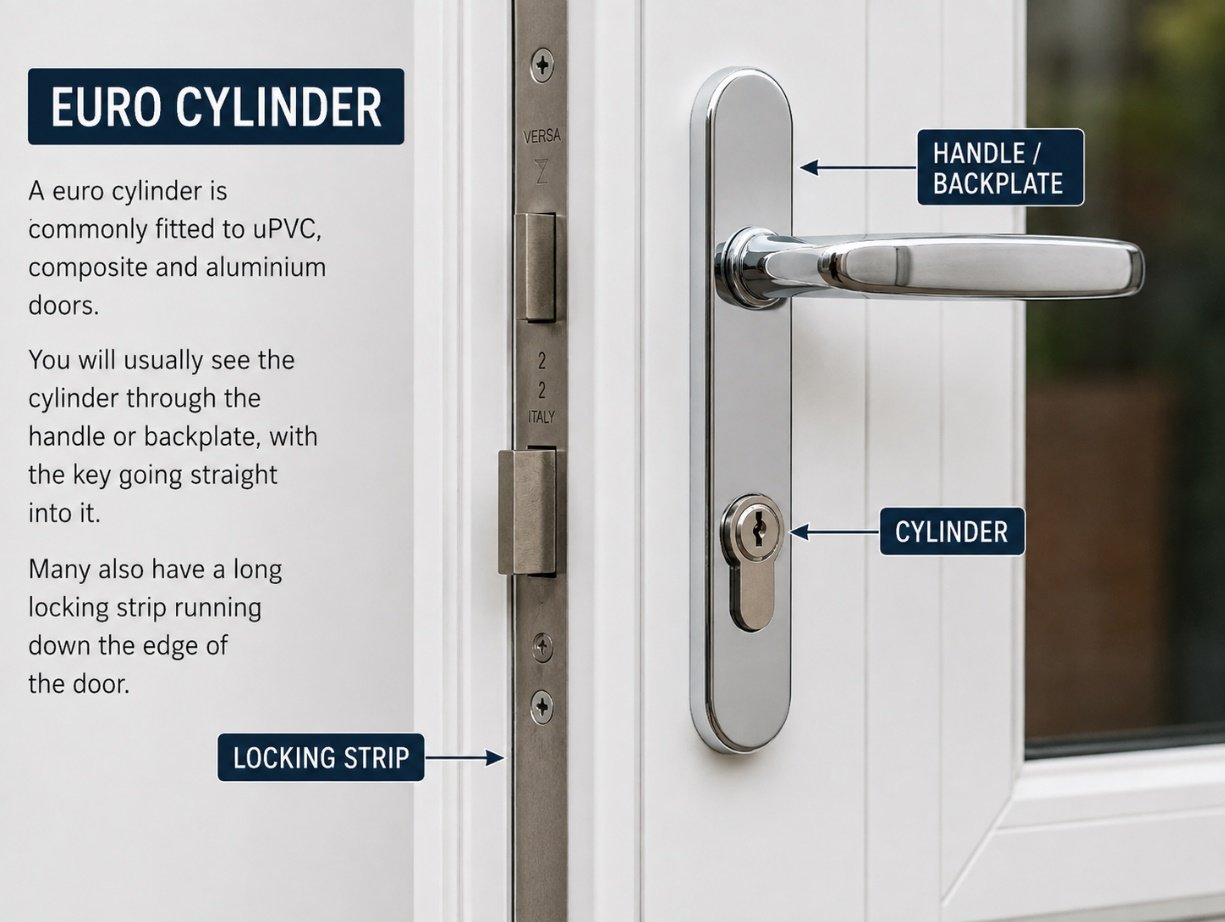
Euro cylinder and multipoint door
The cylinder is the part beneath the handle where the key goes in. The handle and backplate sit above and around it; many doors also have a long locking strip along the edge.
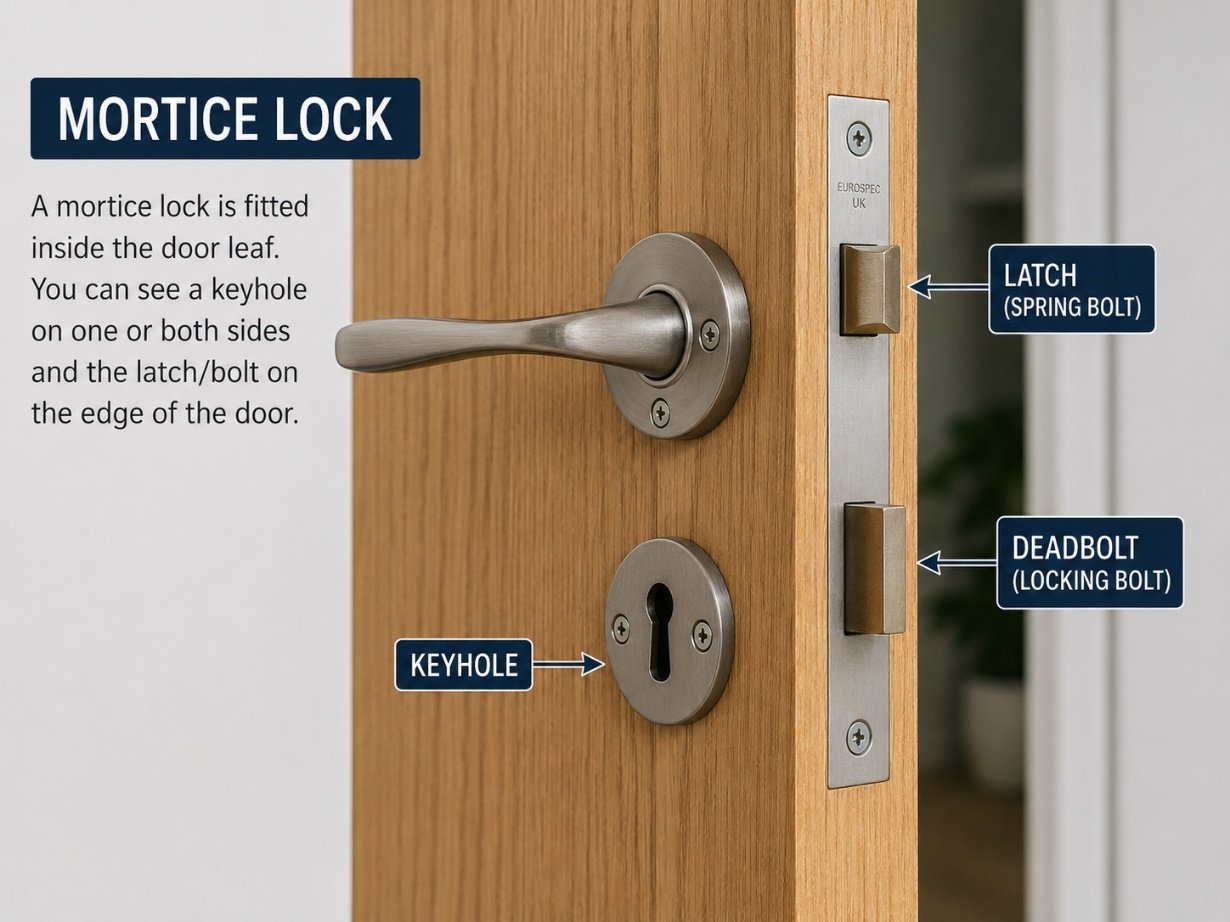
Mortice sashlock in a timber door
The lock case is fitted inside the door. This sashlock example has a handle-operated latch above a separate locking bolt, with a keyhole below the handle. A mortice deadlock has no handle-operated latch.
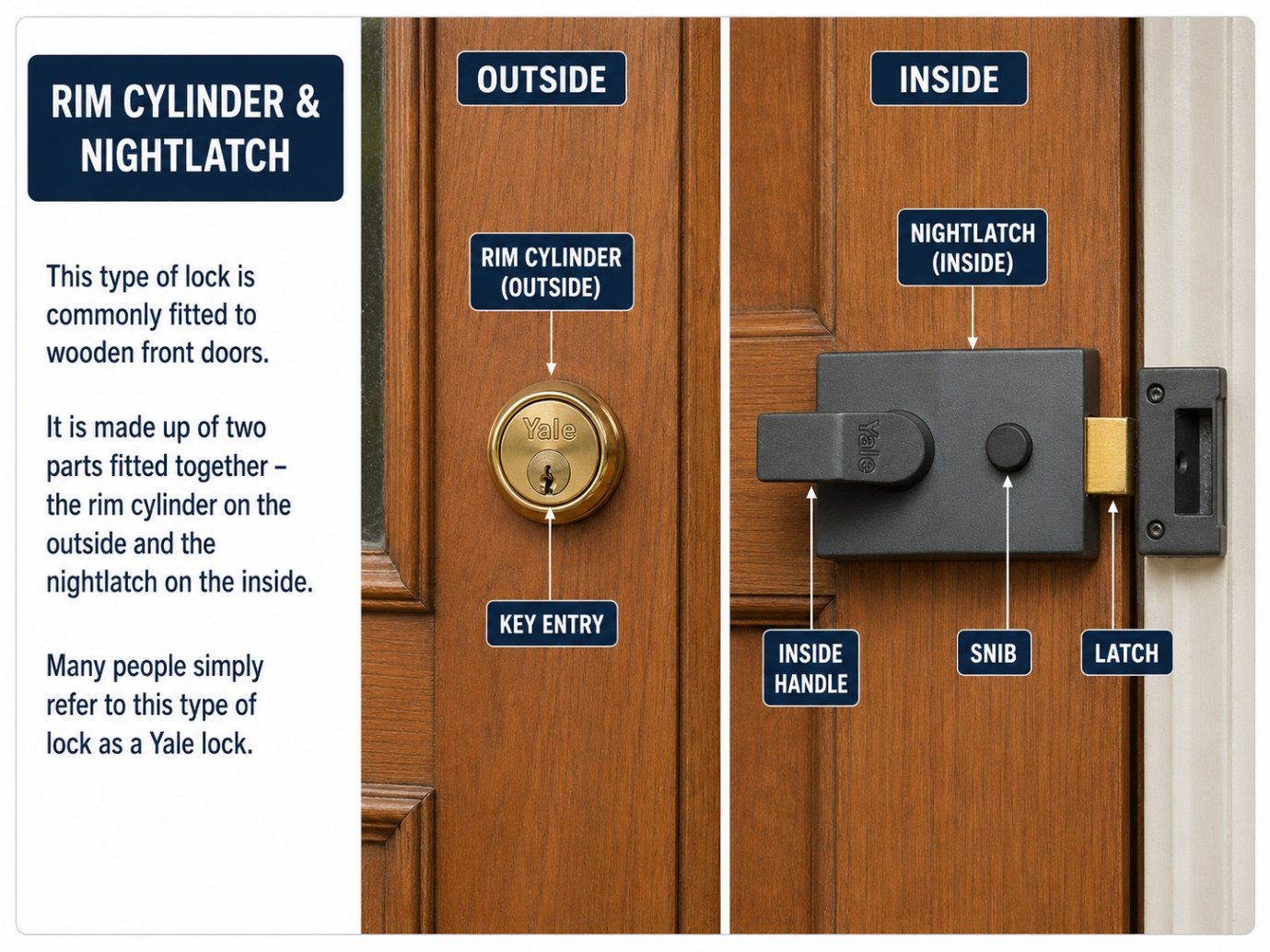
Rim cylinder outside, nightlatch inside
The rim cylinder is visible outside the door. The nightlatch body is fitted to the inside face, with an inside handle and latch. The controls and their operation vary by model.
Security upgrades and missing keys
Should I change my locks if I lose my keys?
Consider who could find the keys and whether they can be linked to your home or business. If their whereabouts are unknown or your address may be identifiable, changing the affected locks is the safer option. We can discuss replacing the cylinder or lock rather than the whole door.
What should I do if my keys are stolen?
We normally recommend changing the locks those keys operate, especially if the keys could be linked to your address. Tell us if the property is unsecured or you also need help getting in. Replacing the affected locks prevents those stolen keys from operating them.
Should I change the locks when I move house?
It is often a sensible step because you may not know how many old keys are in circulation. Former owners, tenants, tradespeople or cleaners may have had copies. Replacing the external locks gives you control over who has a working key and is a useful opportunity to review the existing security.
What is a 3-star lock?
This usually refers to a euro cylinder tested to the TS 007 3-star rating. It is designed to resist a range of attacks, including snapping. Look for the relevant certification and markings rather than relying on an “anti-snap” label alone. The cylinder must also be the correct size and fitted properly.
What does TS 007 mean?
TS 007 is a security specification for replacement lock cylinders and protective door hardware. A 3-star cylinder is one route to a 3-star solution; another is a 1-star cylinder combined with suitable 2-star security hardware. The ratings relate to the tested components, not a guarantee that the complete door cannot be forced.
Are anti-snap locks worth it?
A suitable higher-security cylinder can be a worthwhile upgrade on many uPVC and composite doors. Look for independently certified protection, such as TS 007 3-star, rather than assuming all locks described as anti-snap offer the same resistance. We also check the fit, handles, frame and overall door condition.
Can I upgrade my locks without replacing the whole door?
Usually, yes. A compatible higher-security cylinder, stronger handles or other suitable locking components can improve an existing door. The right option depends on the door’s condition and fittings. We assess the door as a complete system before suggesting upgrades.
Can you change my locks without changing the handles?
In many cases, yes. A euro cylinder can usually be replaced separately from its handles. If the handles are damaged, worn or do not provide suitable protection, we may suggest replacing those too. We will explain what is necessary for the job and what is an optional upgrade.
Can all my doors use the same key—and what does keyed alike mean?
Keyed-alike locks are separate compatible locks set up to work with the same key. It may be possible to use one key for the front, back and another external door, but it depends on the lock types and ranges available. We can check compatibility and discuss the options.
What is a master key system?
A master key system gives different keys access to selected doors while a master key opens several or all of them. It can suit offices, commercial premises and shared buildings where staff need different access. It is different from keyed alike, where the same key operates each of the chosen locks.
Can you help after a burglary?
Yes. We can inspect damaged locks and doors, discuss ways to secure the property and replace suitable locking components where required. Tell us whether the door will close and lock and describe any frame damage. The immediate repair and any further work depend on what has been damaged.
How can I make my front door more secure?
Start with the whole door: its condition, frame, hinges, alignment, cylinder, handles and locking system. Depending on what is fitted, options may include a certified higher-security cylinder, security handles, a suitable British Standard lock or additional compatible hardware. Check any requirements in your insurance policy and keep a suitable means of escape from inside.
Doors and premises we work on
Do you work on commercial doors?
Yes. We help with a range of commercial locks, cylinders, door hardware and locking systems. Send photos and explain how the premises are used so we can identify the fittings and discuss appropriate repair or replacement options. Commercial doors can differ considerably from domestic ones.
Do you work on aluminium doors?
Yes. Aluminium doors are common in shops, offices and other commercial premises, and often use different hardware from domestic doors. We can identify the fittings and assess repair or replacement options. Photos of the handle, lock and accessible door-edge markings are useful before a visit.
Do you repair composite door locks?
Yes. Many composite doors use multipoint mechanisms, and faults can involve the gearbox, cylinder, handles, locking points or alignment. The symptom alone does not tell us which part has failed. We can assess the door and explain whether adjustment, repair or compatible replacement parts are appropriate. See our uPVC and composite door repair advice.
Do you repair patio and French door locks?
Yes. The fittings vary with the door type, age and manufacturer, so identifying the mechanism is the first step. Tell us whether the door is hinged or sliding and whether it opens, closes and locks. We can assess the fault and discuss repairs or replacement parts where available.
Further reading
For independent information about cylinder ratings, see dhf’s guide to TS 007. For lubrication and maintenance, follow the instructions for your exact lock model.
Still have a question?
You don’t need to diagnose it yourself or know the name of the lock. Tell us what happens when you use the key or handle, whether the door is open or locked shut, and your postcode. A photo can help us identify the fittings; we may still need to inspect the door to confirm the fault.
We provide domestic and commercial locksmith services across Hull, Grimsby, Scunthorpe, Barton-upon-Humber, Brigg and surrounding areas. Call to confirm availability and discuss the next step.
Commercial experience
Customers we’ve worked with



B&R Locksmiths
Your local, family-run mobile locksmiths.
24/7 emergency service. No call-out charge.
Hull: 01482 910190
Grimsby: 01472 780190
Scunthorpe: 01724 440190
Mobile: 07822 036283
Useful Information
Services · Door problems · Questions & answers · About us · Contact
Terms & Conditions
Privacy Policy
Cookie Policy & Preferences
B&R LOCKSMITHS LTD
Company number: 17425075
Registered office: One Business Village, West Dock Street, Hull, HU3 4HH (postal address only).